vidéo-club – Spectateur, Ennemi
- Director(s)
- Multiple
- Duration
- 47
- Language
- English
- Subtitles
- French
- Format
- DCP
IMPORTANT INFO
- Latecomers are not allowed in the theatre
- We reserve the right to reassign your seats if they are unoccupied at the beginning of the screening; arrive early to avoid misunderstandings, as we do not show trailers
- Final sales, no exchange or refund
Curatorial statement (Daniel Dinato)
Across the three films selected for this program, directed respectively by Tiuré Potiguara, Vincent Carelli, and Jayce Salloum, a single theme recurs: conflictual contact and dialogue between Indigenous and non-Indigenous peoples-the latter being the position from which I write-in the Americas. Focused on Brazil and Canada-where I was born and where I live, respectively-these films set out some of the consequences of that encounter, from assimilation policies and processes of ethnocide to the dispossession of Indigenous territories and their economic exploitation through extractivism. Here, contact is not presented as a historical event confined to the past, but as a dynamic that runs through and shapes the continent’s present. As the Brazilian Indigenous thinker Ailton Krenak reminds us, the encounter happens daily, and we are still at war. In each of these films, what is staged-if that term can be made to fit here-are different actualizations of the violence inscribed in the inaugural colonial encounter, conventionally situated in 1492, with Christopher Columbus’s arrival at Guanahani.
The films, however, seem to do more. They do not stop at representing antagonism: they embody it, both in form and in content. They themselves emerge from these zones of contact between different worlds, constituted by the tensions and contradictions they make visible. Beyond representing the conflict, they take part in it, and in so doing become one of its vectors. These films function at once as traces and as instruments of intercultural dialogue, seeking to act on reality and to produce concrete effects. In doing so, they wrench the spectator out of a comfortable position of exteriority and call them to account. Rather than a conflict to be contemplated from afar, they reconstitute the relations they bring into play. Non-Indigenous spectators-and, more precisely, White spectators -cease to look on at what might be someone else’s war, and find themselves implicated in the colonial process the films reactivate. These films, in other words, invite us to replay the inaugural contact, and in doing so open up the possibility of repairing that relationship and experimenting with other ways of being together.
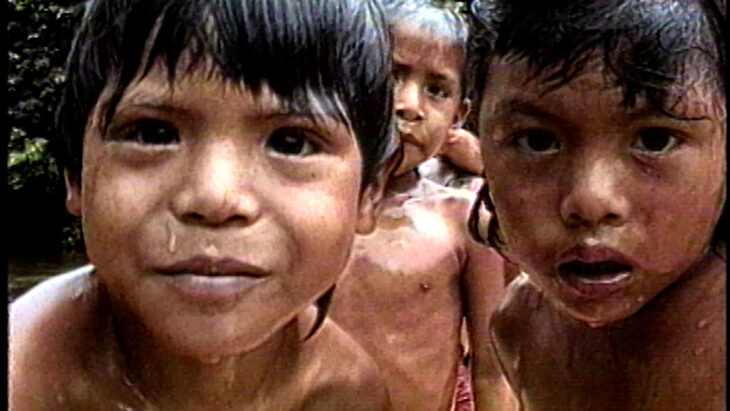
The title, Spectator, Enemy, draws on Vincent Carelli’s film The Spirit of TV. Through several scenes-as when the children look toward the camera and say, “he’s looking through that big thing”-the film reveals the relationship that forms between the one filming, Carelli, and those being filmed, the Waiãpi (an Indigenous nation living in northern Brazil and French Guiana). It is a tense and ambiguous relationship: while the recorded images constitute an archive for the future memory of this Indigenous nation-as the film’s protagonist emphasizes-they could not have existed without the prior destruction of part of their world. That relationship in turn mirrors, on another scale and in fractal fashion, the one between Indigenous and non-Indigenous peoples. The film thus operates as an instrument of communication aimed at gold miners and, more broadly, at white people, reflecting back to us an image of ourselves that is far from pleasant to look at, and that we nonetheless urgently need to confront.
PROGRAM (47 min)
Mekaron, Tiuré Potiguara, 1993, 5 min 40 s – original version without dialogue
The Spirit of TV, Vincent Carelli, 1990, 17 min 40 s – original English version, French subtitles
Untitled part 4: terra (in)cognita, Jayce Salloum, 2005, 38 min – original English version, French subtitles
Biography
Daniel Dinato is a Brazilian independent curator, mediator, and cultural worker. He holds a master’s in social anthropology from Unicamp (Brazil) and a doctorate in art studies and practices from the Université du Québec à Montréal (UQAM). Since 2016, he has maintained a long-term collaboration with the collective MAHKU (Movimento dos Artistas Huni Kuin), developing the practice of the curator-txai-txai meaning “brother-in-law” in the Huni Kuin language-and alongside Ibã Huni Kuin, co-curating the exhibitions Yube Inu, Yube Shanu (2022), MAHKU – Cantos de Imagens (2022), and Vende tela, compra terra (2022, 2024, 2026). Rooted in collaborative methodologies and lasting relationships with Indigenous artists, his work aims to contribute to movements of political and cultural resurgence, sovereignty, and the circulation of Indigenous arts within the globalized worlds of contemporary art. As a non-Indigenous Latin American immigrant who has lived in Tiohtià:ke / Mooniyang / Montréal since 2019, he also works to build lasting ties among artists, communities, and institutions across the Americas, fostering forms of collaboration grounded in reciprocity, listening, and intercultural dialogue.
- Director(s)
- Multiple
- Duration
- 47
- Language
- English
- Subtitles
- French
- Format
- DCP
IMPORTANT INFO
- Latecomers are not allowed in the theatre
- We reserve the right to reassign your seats if they are unoccupied at the beginning of the screening; arrive early to avoid misunderstandings, as we do not show trailers
- Final sales, no exchange or refund